You've got your portrait. It's sitting in your inbox as a very large file, and now there's the slightly daunting question of what to actually do with it. This post is everything I know about turning a digital file into something on your wall that you'll love for years — and a few things I've learned the hard way about what goes wrong.
First: what you actually have
When I send your portrait, you get a high-resolution digital file. High resolution means there are enough pixels packed into it to print big without the image going soft or blocky. In practice, that means you can print it as a small desk frame or a very large statement piece on the wall, from the same file.
It's yours. Print it once, print it ten times, print it again in five years when you move house and the new hallway needs something. There's no limit, no extra fee, and no expiry date. Personal use is completely and permanently yours.
Choosing a size
Most people underestimate how big to go, and then wish they'd gone bigger. A portrait that feels enormous on your laptop screen often looks surprisingly modest once it's framed and hanging on a wall three metres away.
A few honest guidelines:
- A4 (roughly 21 × 30cm) — lovely on a desk, a shelf, or in a gallery wall alongside other frames. Perfect if you want it near you rather than announcing itself.
- A3 (roughly 30 × 42cm) — my personal favourite for a single pet. Big enough to be a proper feature, small enough to fit almost anywhere.
- A2 (roughly 42 × 59cm) — the statement size. Above a sofa, in a hallway, at the top of the stairs. If you have two or three pets in the portrait, this is where I'd go.
- Bigger than A2 — absolutely possible with the file I send. Ask your printer for a test print first if you're going very large, just to be sure you love it at that scale.
My honest advice: measure the wall space with a tape measure, mark the corners with masking tape, and live with the shape for a day. It's a lot cheaper than reprinting.
Where to get it printed
You have three broad options, and they suit different people.
1. A local print shop
Usually the best quality for the money, and you get to talk to a human. Independent print shops and framers will often print and frame in one go, and they'll tell you honestly which paper will suit the artwork. Ask for a giclée or fine art print if they offer it — it uses better inks and lasts far longer without fading.
2. An online printing service
Convenient and often cheaper. Upload the file, pick a size and paper, and it arrives in a tube a few days later. Quality varies a lot between services, so it's worth ordering the smallest size first as a test before committing to the big one.
3. A high-street photo counter
Fast and cheap, and genuinely fine for smaller sizes. The paper is usually glossy photo paper rather than art paper, which gives a shinier, more photographic finish. Some people love it, some find it a bit slick for an illustration.
Paper matters more than you'd think
This is the thing that surprises people most. The same file printed on two different papers can look like two different artworks.
- Matte or satin art paper — my strong recommendation. It's slightly textured, has no glare, and makes the bold flat colours look rich and deliberate, like a proper print rather than a photograph.
- Glossy photo paper — very shiny, very saturated. It can look striking, but it reflects every light in the room and shows fingerprints instantly.
- Textured or watercolour paper — beautiful for a handmade feel. It softens the edges very slightly, which suits the hand-drawn lines nicely.
If your printer offers a paper sample pack, it's a few pounds well spent.
Framing without overthinking it
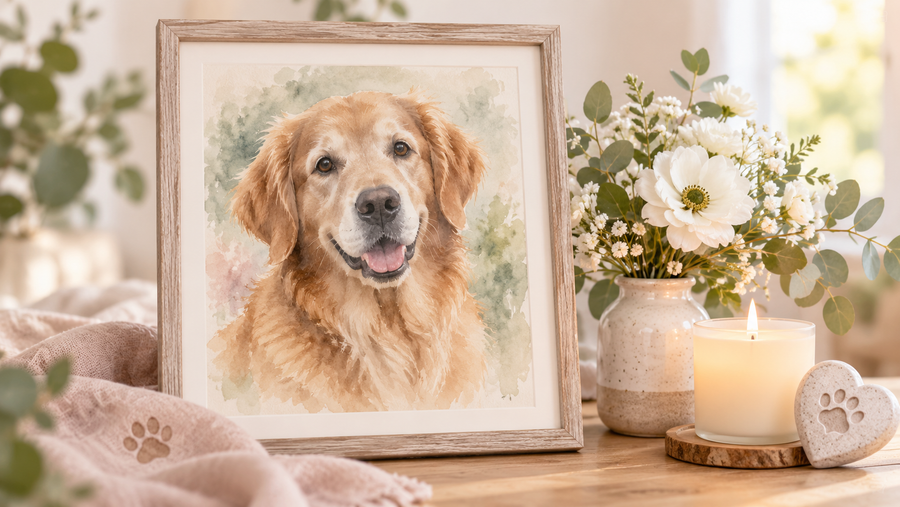
Because these portraits are bright and bold, the frame's job is to stay out of the way. Three combinations that work almost every time:
- Plain white or natural wood frame with a white mount. Classic, calm, lets the colour do the talking. You genuinely cannot go wrong here.
- Black frame, no mount. Graphic and modern. Suits the bold outlines beautifully.
- A frame in one of the portrait's own colours. Braver, and lovely if you commit to it. A deep green frame around a pink-background portrait looks properly considered.
A word on mounts (the card border between the artwork and the frame): they make almost everything look more expensive. A generous white mount gives the portrait room to breathe and instantly makes a modest print look like a gallery piece. If you're choosing between a bigger frame with a mount or a smaller frame without, go with the mount.
One practical note: if the artwork will hang somewhere with strong daylight, ask for UV-protective glass or acrylic. It costs a little more and it will keep the colours from fading over the years. Given these are usually portraits people intend to keep forever, it's worth it.
Where to actually hang it
Some places that consistently work well:
- The hallway. You walk past it several times a day, which is exactly the point. This is where most of my customers end up putting theirs.
- Beside where they used to sleep. For memorial portraits especially, this can be quietly perfect.
- The kitchen. Where the food is. Where they always were.
- A gallery wall. A pet portrait mixed in among family photographs makes complete sense, because that is what they were.
- Above your desk. Excellent for morale.
Hanging height is the thing people get wrong most often. Hang it so the centre of the artwork sits at eye level — around 145–150cm from the floor. Most people instinctively hang art too high. If it's going above furniture, leave about 15–20cm between the top of the sofa and the bottom of the frame so they read as one group.
Other lovely things to do with the file
It doesn't have to end up in a frame. Over the years people have used their portraits for:
- Mugs — genuinely one of the best gifts for the pet's other favourite human
- Tote bags and cushions
- Christmas cards, from the pet, which never stops being funny
- Phone and laptop wallpaper
- Instagram profile pictures
- Birthday cards for the dog, which I fully endorse
- A tiny print in a locket or a wallet
If something goes wrong with the printing
Message me. Truly. If a print comes back with strange colours, or your printer says the file isn't the right format for their system, or you need it resized for an unusual frame — just ask. I'd far rather spend ten minutes sorting it out than have you stuck with something that isn't right.
It's your portrait of your pet. It should end up exactly how you imagined it. 🐾
— Lala x